...In Nineteen Hundred and Sixty-Three; unlike the poet Philip Larkin who had a wholly different reason to regard that year as his
Annus Mirabilis. What's more I was only seven years old, so I'd say that it came at just the right time for me!
More specifically it began in the January of that year with dramatic footage of a storm-tossed galley seen on our old, black and white television. This was live-action footage - presumably taken from some old Hollywood blockbuster - but then, as I watched, it magically transformed into a comic strip image, though the noise of howling winds and crashing waves continued unabated.

This, I was informed by the voice of an excited announcer, was a scene taken from 'Wrath of the Gods' - a story to be found within the pages of a brand new comic called
Boys' World which was "on sale at all good newsagents" even as he spoke. Though I vaguely remember some mention of other stories such as 'The Sea Ape' and 'What is Exhibit X?' there's no doubt that it was the sight of that singular, doomed vessel with the strange eyes painted on its prow that instantly captured my attention and left me desperate to know 'what happened next'.
Sure enough the very next day saw me scuttling home from Mr Norbury's paper shop with the comic in question clutched greedily in my hands. I was, however, surprised to discover that this was the second issue of
Boys' World and not the first. Presumably any TV adverts for no.1 had been shown while I was otherwise engaged or the set was tuned to BBC: such are the vagaries of fate from which our destinies are woven.

Boys' World no.2 - My first issue!
Boys' World no's 3,4,5 & 6 with 'slice of life' covers in the style of adult magazines such as John Bull (later issues displayed a feature called 'What Would YOU do?')

The legendary First Issue - for over twenty years this remained a kind of personal 'Holy Grail' for me until I suddenly came across two copies within weeks of each other (of course, this was long before the world wide web and eBay!)
In those days it was common practice for the first three issues of a new comic to contain a 'free gift', and Boys' World was no exception. The 'Magic Note Pad' which I found loosely inserted within the pages of my new purchase by the newsagent (there were no pre-sealed polybags back then) turned out to be a neat little card with a kind of grey 'screen' in its centre upon which endless drawings or written messages could be 'magically' inscribed with a stylus, only to be deleted with a deft waggle whenever they were no longer required. I was fascinated by this relatively primitive arrangement of cellophane and carbon paper which, in retrospect, seemed to anticipate something of the style and function of modern iPads by nearly half a century!
In other respects, however,
Boys' World was very different from most comics then being published. For one thing there were only four traditional comic strips inside, with the rest of the pages being devoted to educational features and text stories (a combination that had been successfully pioneered a year earlier by Fleetway's
Look & Learn). In many ways it was a cross between a traditional boys' comic and a high quality magazine: an impression that was strengthened by the use of full bleed printing and painted covers.
Surprisingly this bold new venture didn't originate from within the ranks of Odhams' existing editorial staff; instead it was the brainchild of an inspirational American named Jim Kenna who'd only recently arrived on these shores looking for work. According to Michael Moorcock, who wrote many of
Boys' World's early text features, Kenna was hired in the hope that an infusion of new blood would translate into commercial success. Even Robert Bartholomew - the more conventional editor of Odhams' venerable
Eagle - concedes that Kenna's ambition was impressive, reminding him of
Eagle's legendary founder Marcus Morris. For Moorcock he was a breath of fresh air amongst the rather 'dull and self-satisfied' types who were beginning to predominate within the industry. At one time he and Jim even came up with an audacious scheme "to offer a real B-52 as a prize in a competition, knowing no parent would allow their kid to have it in the back garden." As they expected this proposal was instantly squashed by the powers that be!
Along with Moorcock and his writing partner Barrington J. Bayley, Kenna assembled an impressive stable of freelance writers that included his friend and fellow American Harry Harrison, as well as a number of reliable industry veterans such as Tom Tully and Donne Avenell. Unfortunately comic strips were rarely credited in those days so the creative team behind 'Wrath of the Gods' -
Boys' World's full-colour centrepiece - had to remain something of a mystery for the first few weeks.
And make no mistake - 'Wrath of the Gods' was the jewel in the crown of this new title! Just as those initial glimpses on the TV screen had captured my attention, the sight of my first full episode was enough to make me cancel my regular order for
TV Comic and replace it there and then with
Boys' World.

My introduction to the world of Arion the Greek
Finally, on the editorial pages of Boys' World no.14 the mystery was solved when Kenna took the unusual step of crediting the writer/artist team behind 'Wrath of the Gods' in his response to a reader's letter:
 A mystery solved on the letters page of Boys' World no.14
 The men behind 'Wrath of the Gods' - Writer Willie Patterson and artist Ron Embleton
By 1963 Ron Embleton had already established himself as an expert visualizer of the ancient world having recently finished an acclaimed run as writer and artist of 'Wulf the Briton' for Express Weekly, as well as producing superbly researched illustrations of other historical periods for Fleetway's newly-launched educational magazine Look & Learn.
By contrast, writer Willie Patterson was mostly known for his collaboration with fellow Scot Sydney Jordan on the Daily Express's science fiction strip 'Jeff Hawke'. Unlike the workaholic perfectionist Embleton, whose steady path of self-improvement never faltered until his too-early death in 1988, Patterson's career blazed brilliantly for just a few short years before he was overtaken by a debilitating illness in the late 1960s that left him unable to work. Nevertheless, for a period of just over ten years he managed to craft some of the most original series that ever appeared in British comics - including such memorable tales as 'The Phantom Patrol' for Swift, 'The Guinea Pig' for Eagle and 'What is Exhibit X?' - also for Boys' World.
In spite of his aptitude for Science Fiction Patterson had an omnivorous mind that devoured Latin and Greek literature with as much enthusiasm as he studied Astronomy or Physics. As a result his scripts for 'Wrath of the Gods' captured the authentic 'feel' of Greek Mythology, even as he played fast and loose with the archeological facts. Thus, the whole series is structured as a classic quest in which each week's episode opens with a fresh wonder that the hero Arion has to overcome before he is sent on the next leg of his journey with a new instruction from the gods. And while Embleton later confessed to being unhappy with the historical inconsistencies that he had to negotiate, his ability to bring a sense of realism to the most fantastic scenes proved a perfect counterpoint to Patterson's soaring imagination.
One by one, Arion and his comrade Pollodor were confronted by legendary beings such as Charon the boatman, Circe, Cerberus, Medusa, and the terrifying Minotaur - and I gazed on each of these fabulous creatures with wide-eyed astonishment. Out of all of them, however, there were two that are still capable of sending a thrill down my spine some fifty years later.
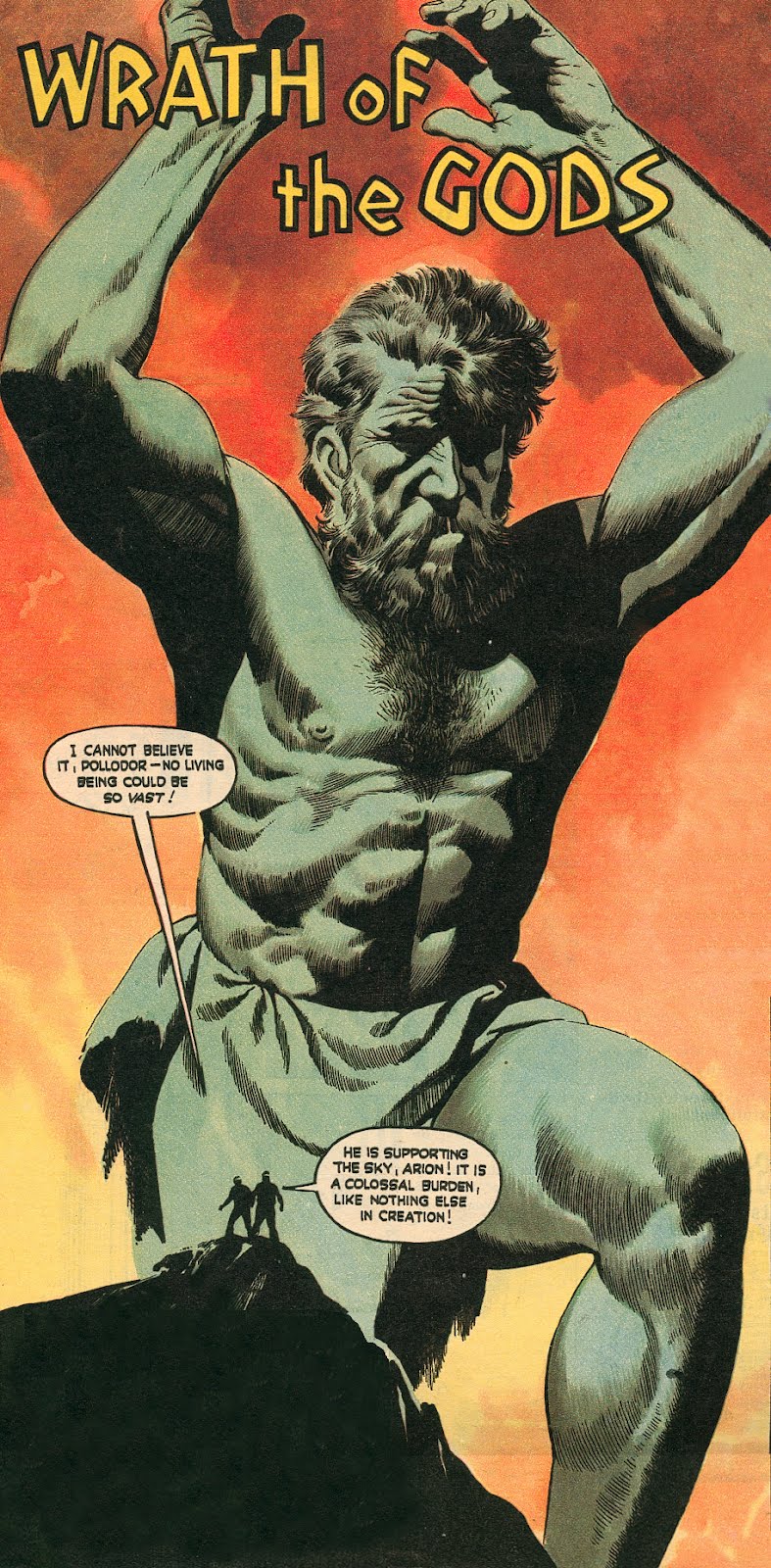
The first was the imposing sight of Atlas, groaning in agony as he held the secret pillars of the sky on his shoulders - a burden that Arion himself had to share for a brief moment! In the sequence shown below it's possible to see the thrilling way in which the final panels of one week's episode would invariably anticipate the next week's dramatic opening.

 Arion and Pollodor gaze in awe at the towering figure of Atlas
The other sequence which burned itself into my memory was a perfect example of Patterson's deliberate blurring of history as Arion - introduced in the very first episode as a veteran of the Trojan Wars - gazed on the fabled Colossus of Rhodes: one of the so-called 'Seven Wonders' of the Ancient World that shouldn't even have existed for another 900 years! The statue's dramatic location astride the harbour entrance was also something of a invention, though in this case Patterson was simply following an error that had arisen in Medieval times (and one which supposedly inspired Shakespeare's description of Caesar 'bestriding the narrow world').
 Arion enjoys a preview of one of the Seven Wonders of the World!
In the event, Arion and his shipmates were forced to take their leave of Rhodes with undue haste, which led to a desperate race against time as the galley's oarsmen strained their muscles in a futile attempt to clear the looming giant before its engineers could unleash their terrible weapon: a gigantic bowl of burning oil capable of turning the harbour entrance into a wall of fire!
 Arion loses yet another ship!
Strangely enough I recalled this sequence just a few months later when my Dad took me to see Ray Harryhausen's classic film 'Jason and the Argonauts' at Stoke's Esseldo cinema. In fact we were so impressed by the Argonauts' battle with the bronze giant Talos - especially the part where they tried to escape by rowing beneath his legs - that we sat through the beginning of the film for a second time (not to mention the rather dull support feature 'Siege of the Saxons') in order to watch it again!
 Jason and the Argonauts face Talos in Ray Harryhausen's 1963 film
For years afterward I wondered if the remarkable similarity between these two scenes (both of which must have been in production at roughly the same time) could have been related in any way. Since then, however, I discovered that only two years earlier the young Sergio Leone had directed an Italian 'Sword & Sandal' epic which featured a very similar version of the Colossus, complete with inbuilt defensive weapons. If this rather embarrassing melodrama provided a spark of inspiration for both Patterson
and Harryhausen it certainly wouldn't be the first time that dross had been turned to gold through a minor act of creative plagiarism.
 Sergio Leone's 1961 epic 'The Colossus of Rhodes'
Sadly, Ron Embleton only remained with 'Wrath of the Gods' for the first 23 episodes - yet this first quest, in which Arion travelled to the land of the dead itself in order to recover the Lost Bow of Delos, led directly to a second adventure in which a young John Burns took over the artistic reins. In fact,
Boys' World no.24 marked a major change in the title as it reverted from the stylish magazine format to a traditional
Eagle-style layout with white margins around every page. At roughly the same time Odhams, alarmed that Kenna's singular vision wasn't being matched by equally extraordinary sales, decided to replace him with the much less maverick figure of Bob Bartholomew, who went on to edit both
Eagle and
Boys' World until the two comics were finally merged together in late 1964.
Amongst Bartholomew's changes were the introduction of two science fiction strips: 'The Iron Man', about a crime-fighting robot in human disguise (drawn by Ron's younger brother Gerry), and 'Brett Million', about an interstellar adventurer whose initial outing was adapted from Harry Harrison's first 'Deathworld' novel. And as Frank Langford's florid artwork for the latter series was granted pride of place in the comic's centrespread this meant that 'Wrath of the Gods' was relegated to a single page on the back cover.
 John Burns' first episode as Arion embarks on a new quest
I can't help feeling that Gerry Embleton should have been the natural choice to take over from his brother (as he had done with 'Strongbow the Mighty' in
Zip) - especially since John Burns' attempt to follow Ron on 'Wulf the Briton' in the last few issues of
TV Express had proved anything but successful. Nevertheless Burns had clearly improved considerably in the intervening period so that his first Arion pages, though rarely spectacular, provided an acceptable approximation of the look that Ron Embleton had established, and the 'Quest for the Nameless God' turned out to be a worthy successor to the initial series.
Then bit by bit something strange happened as John Burns' own style began to emerge with ever-increasing confidence; and, as if in recognition of his growing mastery, 'Wrath of the Gods' was restored to its old position on the centre pages in time for the beginning of a brand new quest as Arion set out to help his friend Klobbax in a search for the Weapons of Ajax.
Over time Burns developed a real talent for dynamic penmanship (very different from Ron Embleton's brushwork) as well as an idiosyncratic palette in which dirty greens, browns, blues and greys predominated, yet out of which sudden splashes of red, yellow, purple or shocking pink could startle the eye at any moment with all the force of a lightning bolt in an overcast sky. In a way this technique was well suited to tales in which the mundane reality of the mortal world was constantly juxtaposed against the timeless magic of the gods. What's more, there was a sense in which the loss of Embleton's jewel-like colours was matched by the direction of the storyline for, having confronted all the most famous marvels of Greek mythology, Arion's fourth and final quest sent him far beyond the Pillars of Heracles and the sparkling blue Mediterranean, through grim northern seas to the mysterious, mist-shrouded island of Britain.
 The Pillars of Heracles!
Here, in a land haunted by Werewolves and Krakens, Arion and his travelling companions found themselves at the mercy of a whole new pantheon of savage gods such as Wodin and the devious Loki as they sought to recover the Future-Stone, a powerful mystic artifact that had been stolen from Olympus itself aeons before. But all their previous trials paled into insignificance when the three Norns - almighty weavers of destiny for gods and men alike - rose up from their Cave of night, threatening Arion with horrors beyond imagining: even if it meant war in heaven.
And at that point the world came to an end...!
...Or at any rate
Boys' World did (accompanied by the traditional announcement of 'Exciting News' for all readers!).
 'Exciting News!' - The old lie dreaded by British comic readers
Fortunately Odhams allowed the storyline to continue for six more weeks in the pages of the combined
Eagle & Boys' World where 'Wrath of the Gods' briefly rubbed shoulders with Frank Bellamy's 'Heros the Spartan'. Thanks to the intervention of the Greek Fates Arion and his comrades managed to escape from the Norns, allowing them to track down the Future-Stone in a Druid temple. No sooner did Arion hold the glittering jewel in his hands than he and his friends were transported instantly back to Greece and the throne room of Olympus.
All that remained was a procession of the mighty beings that Arion had contended with during the course of his four quests as each one in turn - from Atlas on his mountaintop to the Minotaur in his blood-soaked arena and Cerberus at the gates of Hell - saluted him one last time for his valour. Then, in the words of Zeus himself, Arion's tasks were finally over and the Wrath of the Gods was ended!
 The Minotaur hails Arion for one last time (taken from the original art)
 "The Wrath of the Gods is ended!" (taken from the original art)